

The Path of the Thorn
Not all threats fall to the sword. Some must be felt before they are found.
Form & Visible Interactions
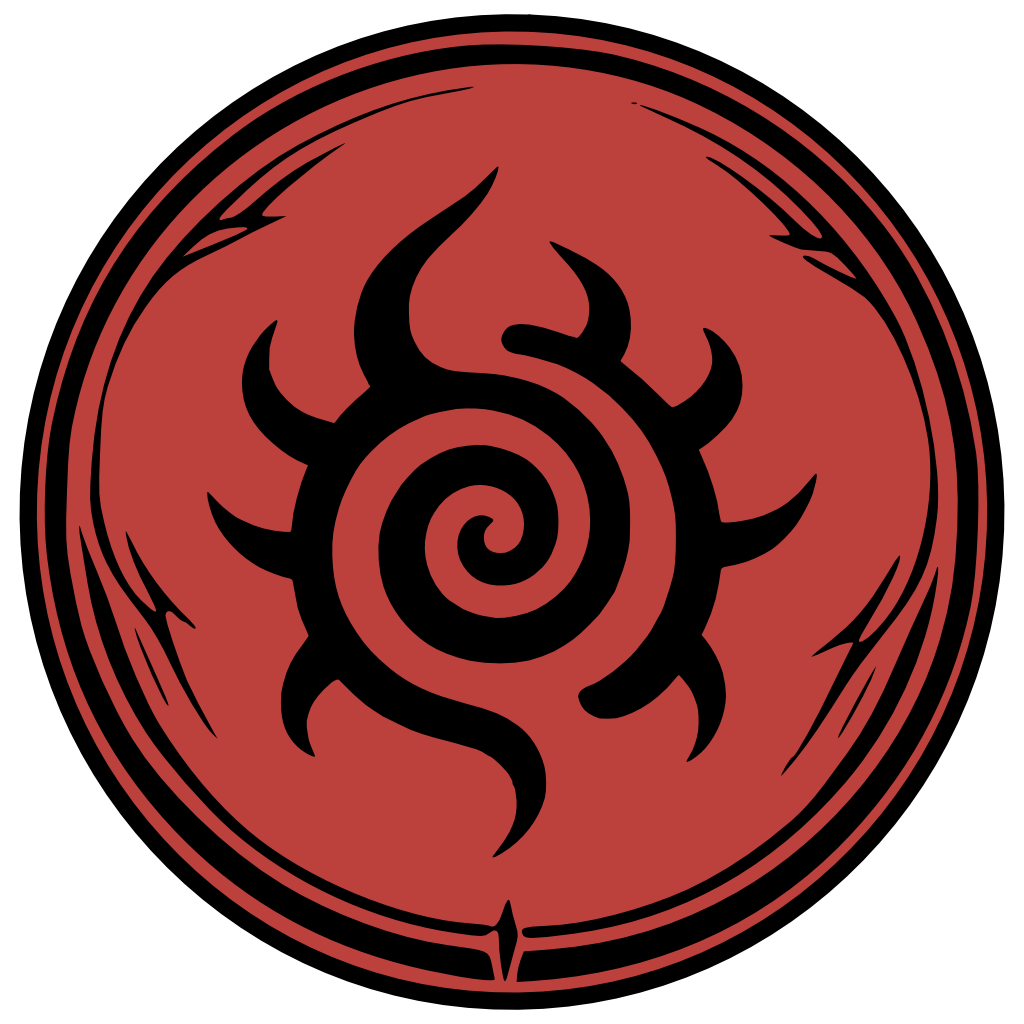
The Thorn mark is composed of barbed curls, tightening spirals, and hooked lines that seem to coil inward before threatening to strike outward again. The Thorn’s geometry is compact, guarded, and difficult to read at a glance. Each curve terminates in subtle points rather than clean ends, suggesting briars, hooks, or coiled bramble under tension. Its design often resembles a thorn-wrapped spiral or a bramble vine drawn in deliberate restraint, layered in an asymmetry that implies concealment rather than display. Even when fully visible, the mark rarely feels like it wants to be seen. The Thorn is one of the most misunderstood Paths in visible form, as its geometry is described as that of held response.
The Thorn waits. Its inward coiling is interpreted as readiness preserved, not aggression declared. The barbed terminations suggest that what is protected may wound only when pressed. In this sense, the mark’s form expresses not open violence, but defensive nearness to it.
The most common placements
The Back where it generally sits centred across the lower back, the spiral tends to rest near the spine, protecting what many glyph-readers call the body’s hidden axis.
The ribcage where the barbed lines of the mark often follow the curve of bone, tightening toward the sternum without ever fully reaching it, as if guarding the vulnerable interior without exposing itself to the front.
The shoulder or beneath the shoulder blade, the mark frequently appears as a coiled brace of barbed curls, half-visible only when the bearer turns or reaches.
Rarely does the Thorn manifest in openly visible positions, all areas are naturally concealed by clothing, cloaks, armour, or ordinary posture. As the mark appears where concealment is most natural, its placement reinforces the long-standing belief that the Path is meant to guard through obscurity rather than presence.
In daylight, the Thorn mark appears as deepened lines of healed scar tissue with a faint red-brown undertone, as though old ink or dried blood had settled beneath the skin and refused to fade entirely. Its texture is often slightly more pronounced than that of softer Paths, though not raised enough to announce itself unless touched or closely examined. Under moonlight, it ignites in deep crimson, rust-brown, or muted wine-dark radiance. The Thorn’s glow is dense and close-kept, though it does not merely glow, it gathers. It seems to cling to the skin rather than cast outward, swallowing much of its own light. Witnesses sometimes describe it as the glow of banked coals beneath ash or blood-dark light trapped beneath glass.

Core Nature:
The Thorn mark is not a mark of malice. It is a mark of caution. Thorn-marked individuals often display heightened environmental awareness and a striking instinct for managing exposure. They notice who is listening before they speak. They measure distance to exits without seeming to look. They shift posture subtly to avoid open attention and often develop the habit of revealing only as much intention as the moment requires. While this can resemble deceit, more often, it is simply adaptive intelligence honed before the bearer even has language for it.
Thorn-marked individuals are kind by temperament, their caution is rarely cruelty. The Thorn merely tends to foster survival-minded perception. Its bearers often read rooms quickly, register unspoken tensions, and anticipate changes in mood or danger before others do. They are often skilled at moving through crowded spaces without drawing notice, watching before acting, and preserving options until certainty becomes possible. In unstable environments, such instincts are invaluable. The Path is marked more by quiet endurance than by inherent harshness. Many Thorn bearers are deeply loyal once trust is established, though they seldom grant that trust quickly or without reason. They often protect others through foresight, discretion, and unacknowledged labour rather than open declarations of care.
Social Role & Superstitions:
The Thorn moves between structures, along edges, behind declarations, and beneath surfaces. It senses weakness in barriers before they collapse. Its task is interception through awareness. However, when a society repeatedly treats caution as duplicity, many Thorn-marked people are pushed into roles where secrecy becomes not just habit, but livelihood. The Path itself does not demand darkness. It adapts to it. The Thorn exists in ambiguity, it is praised in theory as necessary hidden vigilance and distrusted in reality as a mark too comfortable in shadow. The Thorn exists because not all corruption arrives at the gate. Some of it passes quietly through the hedge, grows under the eaves, or settles in the fold where no sword was drawn because no threat seemed visible yet. In that sense, the Thorn is protective in a different register. Where others hold the line, the Thorn watches what slips beneath it.
Among common folk, the Thorn is associated less with open terror than with sustained unease. The Thorn tends to evoke suspicion first and understanding only later, if at all. Certain families quietly hang bramble charms near back doors when travelling kin return, believing the Thorn’s nearness helps notice danger approaching from the route others do not watch. Even distrust occasionally leaves room for reluctant respect. A darker superstition persists that if a Thorn mark ever blooms outward beyond its original spiral, the bearer has crossed some line they cannot return from. Whether true or not, the belief reveals something important about Arynbel: it does not only fear what the Thorn can do. It fears what hidden endurance might become if pushed too far.
Common Roles in Society:
Herdkeeper: Those who manage cattle, marsh ponies, stonehorns, goats, and other domestic stock are usually expected to be Root-marked, however the Thorn serves as the practical next-best in rougher country, where herding becomes half guardianship, half route-work. Thorn-marked herdkeepers are especially common near danger zones, uplands, or border routes where watching the land matters as much as tending the animals.
Scout: The scout belongs to Thorn through route instinct, danger sense, and survival along uncertain edges.They are able to move with ease through unstable and especially harsh terrain.
Messenger: the usual work includes speed, the route ahead, edge-reading, and survival. Thorn suits that most naturally, as it bears the ability to sense and flow through unseen dangers.
Bard or Storykeeper: While the Tide is the obvious mark of carried memory, spoken history, and communal narrative. A Thorn-marked becomes next-best when the stories are road-borne, hidden, outlawed, or carried between dangerous places.
