


The Path of the Root
What grows unseen feeds what stands in light. A Root keeps the roof standing. Do not mock the hands that plant your bread. When the Root fails, the realm starves.
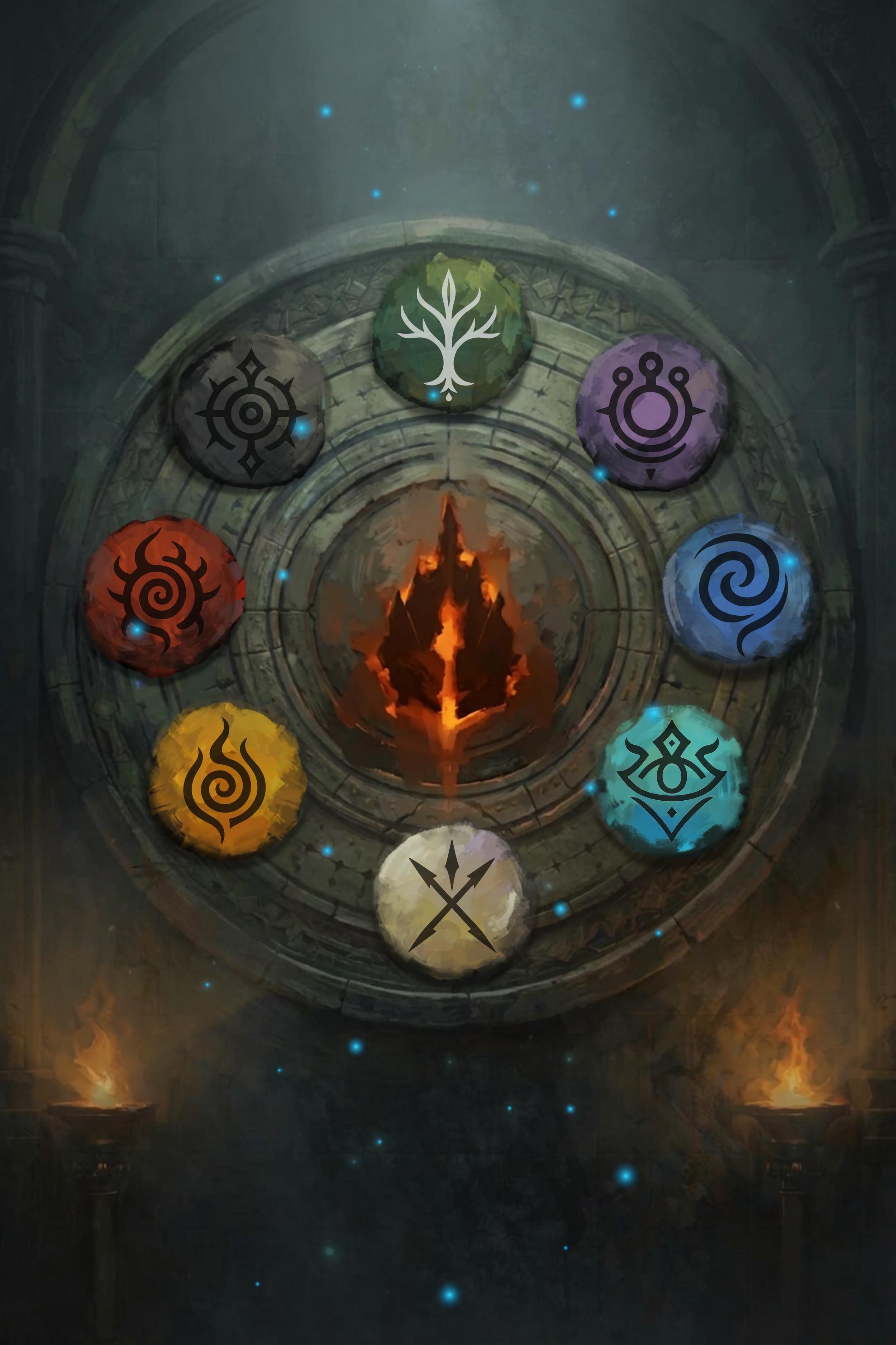
The Root mark is composed of branching arcs, growth-ring circles, and layered lines that radiate outward from a central core. The Root’s geometry expands rather than strikes. Its lines fork gently and persistently, overlapping like tree limbs, root webs, or river deltas spreading through receptive ground. In many manifestations, these branches gather around circular or semi-circular bands reminiscent of cross-cut wood, revealing a structure that suggests age, endurance, and quiet accumulation rather than sudden force. The mark does not imply conquest. It implies continuance.
The Root as one of the clearest visual expressions of sustenance within the Eight Paths. Its central ring is often interpreted as the self anchored in purpose, while the outward branching lines signify labour extended into family, craft, shelter, harvest, and community. The Root invites attention to spread. It teaches that what matters most is not always where force is applied, but how stability is carried outward through repeated acts of maintenance. In orthodox interpretation, every branch is a burden accepted. Every ring is time survived.
Common placements
The spine where the mark follows along the spine, the central ring often rests between the shoulder blades, with branching lines extending downward in subtle arcs that follow the vertebrae like a stabilising lattice beneath the skin.
The outer thigh where the mark curves with muscle and tendon, spreading like a rooted network through the strength that carries labour forward.
More rarely, the Root appears across the hip, lower ribs, or high calf, but even these placements continue the same symbolic logic: the Path manifests where the body supports, endures, and keeps moving under load.
In daylight, the Root mark resembles faint bark-lines, weathered grain, or concentric scars pressed gently into flesh. Its texture is usually subtle, though older marks sometimes appear slightly deeper at the central rings or where the branching lines fork most often. Under moonlight, it ignites in stone green, bronze-gold, or muted earthlit radiance. The Root glows steadily and softly, its light diffused and grounding. It is described as deep rather than bright, as though the illumination rises from within the body instead of resting upon the skin. It rarely demands attention, yet once noticed it is difficult to dismiss.
Form & Visible Interactions

Root-marked individuals often display patience, consistency, and a surprising instinct for reinforcing the lives around them. They are the people who remember what is missing from a table, who calm disputes not by commanding attention but by restoring rhythm, who return tools to their place without being asked, and who quietly assume responsibility when no one else has noticed it has been dropped. Their gifts are not usually dramatic. They are cumulative. The Root forms people who understand, often without instruction, that many forms of survival depend on what is repeated faithfully.
Their temperament leans toward endurance rather than reaction. Root bearers often absorb hardship without announcing it, not because they do not feel strain, but because they tend to convert pressure into task. Many have a strong tolerance for monotony, repetition, and long labour whose rewards are delayed or shared outward rather than felt personally. In conflict, they are more likely to reinforce than to initiate, repair rather than fracture, and preserve than to seize. This same steadiness can lead others to underestimate them. Because the Root is associated with maintenance, care, and continuity, its bearers are often assumed to lack ambition, originality, or strategic imagination. The Root does not seek spectacle, nor is it passive. A Root-marked person may seem quiet in council and still be the one who best understands what will actually keep the walls standing when proclamation has ended. The Root ensures that something remains worth defending when the fires cool and the banners come down. Its strength is rarely glamorous. It is foundational. And because foundations are most noticed when they fail, the Root is one of the most relied upon and least celebrated Paths in Arynbel.
Core Nature:
Social Role & Superstitions:
The Root is the most common Path in Arynbel, and is divine because it sustains what others stand upon. The Root preserves the conditions under which governance, purification, and defence remain possible. It represents the Weave’s investment in persistence: food through winter, walls through storm, record through neglect, community through grief. Its prevalence has shaped entire industries, customs, and assumptions about social order. Farmers, millers, masons, herbalists, builders, cooks, quartermasters, carpenters, ledger-keepers, irrigation planners, and wardens are overwhelmingly Root-marked. Most craft guilds historically favour Root bearers, with the assumption that Root-marked individuals are best suited to making, maintaining, and managing has created both opportunity and rigidity.
Arynbel often treats the Root as proof of competence, but only within boundaries it finds comfortable. Root bearers tend to become the stabilising centre within villages, workshops, monasteries, and supply systems. Though, the Root is respected but rarely celebrated. Common people tend to speak of it with relief rather than awe, gratitude rather than wonder. In rural regions, Root-marked births are often welcomed with visible relief, especially in families tied to land, livestock, storehouses, or skilled craft. In mercantile towns and cities, the mark is considered fortunate for trade houses and guild families who depend on continuity across seasons and generations. One persistent superstition claims that if a Root mark ever splits cleanly in two, famine follows.
Common Roles in Society:
Herbalist: Herbalists are most often Root-marked, especially in rural settlements where plant knowledge is tied to continuity, season, and household survival. Root suits the patient, accumulative knowledge required to recognize growth cycles, drying methods, useful weeds, and the difference between medicine and poison.
Tanner: Tanning is repetitive, foul, slow, and materially foundational, all of which make it strongly Root-aligned despite the common assumption that any transformative craft belongs to Flame. In Arynbel, leather is less a spectacle than it is continuity.
Dockmaster: A dockmaster must hold order over traffic, goods, vessels, schedules, and civic flow. Root suits the administrative and structural continuity of that role.
Healer: While the Flame is the expected healing mark in many formal structures because it refines, cauterizes, purifies, and responds actively to injury. A Root-mark follows where healing is steadier, slower, herbal, domestic, and based in endurance rather than direct intervention.
