


The Path of the Flame
A steady flame warms a village.A wild flame leaves only ash.When the fire sings, the gods are near. Through fire, the pattern is restored. Through heat, the impurity is named..
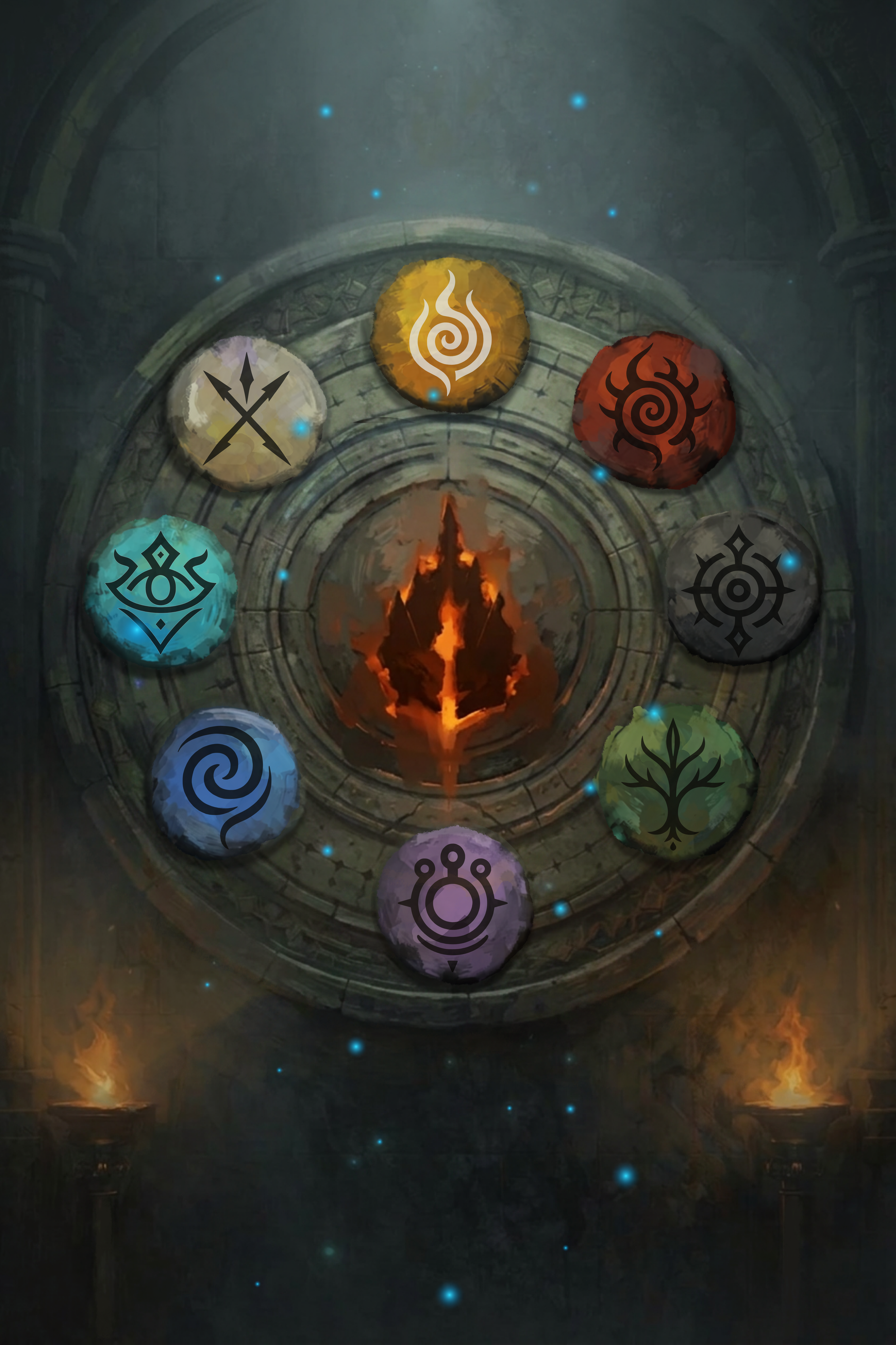
The Flame mark is composed of spiralling sigils that radiate outward in layered arcs, often resembling stylised sunbursts, curling tongues of fire, or concentric waves of heat rising from a forge. The Flame’s design is fluid yet controlled, formed from looping strokes that expand, narrow, and rejoin as though drawn in motion rather than fixed at rest. At its centre, the lines commonly gather into a dense knot of glyphwork from which brighter arcs extend outward like pressure released through heat. The mark rarely appears static, even when unlit. Its structure suggests continual becoming. The inward knot is commonly taught to represent concentrated purpose, suffering, or conviction, while the outward arcs signify that such force cannot remain enclosed forever. Heat must radiate. What is ignited must either warm, refine, or consume. It is movement from one state into another.
Common placements
The chest and Sternum where the mark spreads outward from the heart and over the lungs, as though breath itself feeds the pattern. This placement is associated with conviction, voice, fervour, and the inner sustaining fire of faith.
The hands and palms where the sigils often trace the palms, fingers, and inner wrist, aligning with touch, ritual gesture, blessing, and the act of deliberate transformation.
Fire singers, healers, ash-priests, and sanctifiers are frequently recorded as bearing the mark in both locations simultaneously, the chest and hands resonating in tandem. Scholars have long interpreted this dual placement as symbolic of breath and action joined through flame.
In daylight, the Flame appears as fine, curling lines with a faint warmth in their hue, sometimes tinted gold or copper even when fully dormant. Under moonlight, however, it ignites in amber-gold radiance edged with ember-like flickers of deeper orange and red. The Flame’s light dances subtly, as if stirred by air no one else can feel. In moments of invocation, heightened emotion, or ritual intensity, small sparks may appear to leap between arcs before settling again into steady burn.
Form & Visible Interactions

The Flame is a mark of intensity. Flame-marked individuals often display strong emotional currents and unusually visible inner life. Joy is expressed fully. Anger rises fast. Grief cuts deep and lingers hot. Their presence tends to affect others even before they speak, and many possess a natural charisma that can stir courage, confession, devotion, fear, or imitation simply through tone, gaze, or force of conviction. Flame-marked individuals frequently show an instinct toward transformation in whatever form they understand it. They do not simply participate in the emotional weather of a room. They alter it.
Those who master their temper often become stabilising hearthfires: steady, radiant, and capable of guiding others through confusion and darkness without being consumed by it. Those who fail to temper themselves may become volatile, doctrinaire, and dangerously certain that whatever burns hot within them must therefore be righteous. Restraint is not the absence of fire. It is the shape that keeps fire from devouring what it was meant to preserve. The greater the inner flame, the more beautiful its light under discipline, and the more catastrophic its release when discipline fails.
Core Nature:
Social Role & Superstitions:
Fire, in temple theology, is not treated as destruction alone. It is revelation through consumption. It reduces corruption to ash so that new growth may take root. The Flame Path is understood as the divine crucible through which impurity is named and transformed. The Flame sits at the threshold between judgment and renewal. Its bearers serve as visible reassurance that divine force can still be felt, still witnessed, still called down into matter.
Across Arynbel, the Flame is treated as one of the most publicly legible signs of divine activity. In smaller villages, Flame-marked individuals may tend communal hearths, preside over seasonal rites, bless the dead, assist in difficult births, or oversee ceremonies meant to protect crops, homes, and thresholds from unseen decay. Flame bearers are rarely neutral figures in society. They warm the realm, sanctify it, and, when called upon, burn through it.
The Flame inspires devotion tinged with caution. It is one of the most beloved Paths in prayer and one of the most feared when embodied by the wrong person. The people of Arynbel understand instinctively that fire is precious because it gives light, and dangerous because it never gives light alone. The Flame is trusted to sustain, bless, and purify, yet everyone knows that those same gifts may become justification for ruin if governed by zeal rather than wisdom. Some whisper that a Flame-marked person who never loses their temper has buried something catastrophic within. Others say that if the mark ever burns blue-white instead of amber-gold, divine displeasure is near. Most commonly, people do not fear that the Flame will go out. It fears that it will burn wrong.
Common Roles in Society:
Healer: Flame is the expected healing mark in many formal structures because it refines, cauterizes, purifies, and responds actively to injury. Flame-marked healers are especially important where major damage has been taken, as they are able to provide more drastic mending than many herbal practices can.
Apothecary: Apothecaries are usually expected to be Flame-marked because their work involves refinement, preparation, dosage, and active transformation. The Path’s association with correction and controlled reaction makes it especially trusted in urban medicine and temple-sanctioned healing.
Soap or Candlemaker: Soapmaking and Candlemaking belongs first to Flame through heat, rendering, and transformation of rough matter into cleansing substance. Candles are small vessels of ordered fire. The work depends on measured heat, consistency, and the shaping of light into durable domestic form. Both are humble work, but one strongly aligned with the Path’s practical purgative qualities.
Brewer: The Flame mark excels in this craft as it heavily involves controlled transformation, fermentation oversight, heat management, and ritualized preparation.
