


The Path of the Blade
A bright Blade keeps wolves from the door. Steel does not ask why. When the Blade dulls, the rot begins. Mercy without edge invites rot. The Blade remembers what must be severed.
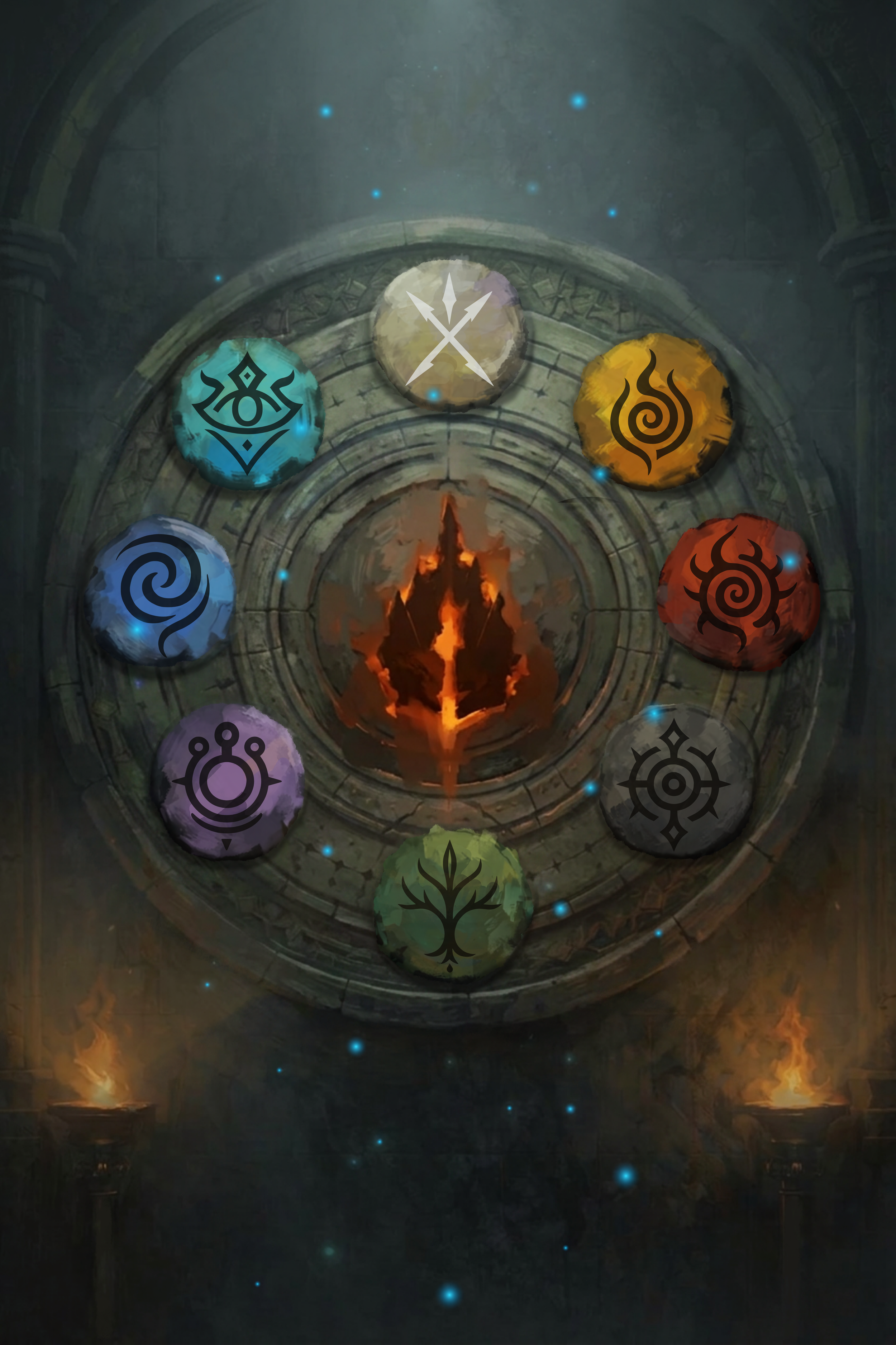
The Blade mark is composed of sharp, angular runes that resemble the edges of honed steel. Its lines intersect at decisive points, forming shapes reminiscent of weapon edges. Crossguards, descending strokes, and split tips that imply forward motion and immediate intent. Blade’s geometry is linear, directional, and severe. It does not gather inward. It drives outward. Nothing in its form suggests contemplation for its own sake. It is a mark of edge, force, and action made visible in flesh. The Blade implies choice narrowed into movement. Its lines are read as commitments already made. Intersections are interpreted as moments of decision. Split angles are taught as signs of pressure, momentum, and consequence.
Common placements are along areas where motion begins and force is carried through the body.
The shoulder where the mark usually displays etched along the deltoid following muscle contour with almost anatomical precision, aligning with the bearer’s striking arm and suggesting purpose housed within strength.
The Forearm placement displays runes which often track the length of bone and taper near the wrist, as though guiding the hand toward its appointed use.
However, the Blade Path shows more variation in placement than any other major mark. Historical records confirm manifestations along the thigh, collarbone, calf, ribline, and even across the back of the hand. Scholars generally interpret this variability as proof that the Blade responds to capacity rather than ceremony. It appears where the body most naturally expresses force, readiness, or decisive motion.
Blade mark responds most visibly during moments of imminent threat or decisive action. Its glow intensifies sharply and briefly, especially at outer angles, split junctions, and the tips of descending lines. The brightening often occurs with startling immediacy, as though the mark answers the body before conscious thought fully catches up. It does not pulse in ceremony. It flares in commitment. The lines may appear slightly thicker beneath moonlight, and the steel-blue edge may deepen toward the joints where motion is most frequently expressed.
Form & Visible Interactions

Blade-marked individuals often display heightened reflexes, direct movement, and an instinctive orientation toward confrontation rather than avoidance. Many notice imbalance quickly and react to it without waiting for others to name it. Where some children shrink from conflict, Blade-marked children often move toward it, not always from aggression, but from a deeply rooted refusal to let danger remain unanswered.
The Blade often produces individuals who prefer decisive action, direct speech, and visible outcomes over ambiguity, passivity, or long uncertainty. Some Blade bearers are disciplined, restrained, and capable of extraordinary patience before striking. In such individuals, readiness becomes vigilance rather than volatility. Others struggle in times of peace, growing restless, irritable, or drawn toward unnecessary confrontation simply to satisfy the internal pressure for engagement. In its healthiest form, the Blade fosters courage, loyalty, sacrifice, and protection under strain. In its most damaged form, it can become aggression, intolerance, impulsiveness, or dependence on force as the fastest answer to complexity.
Core Nature:

Social Role & Superstitions:
Blade-marked individuals form the backbone of Arynbel’s martial institutions. Across the kingdom the Path is often treated with both respect and caution. A Blade bearer is someone meant to hold the wall, walk the dangerous road, or stand between order and what would pierce it. In frontier regions, they are prized as defenders against raiders, beasts, and instability. In urban centres, they are often drawn into institutional protection roles represented among soldiers, sentinels, executioners, caravan escorts, city watch captains, noble wardens, and sworn protectors of sanctums, courts, and archives.
However, a blade without discipline does not become harmless. It becomes hungry for justification. It seeks something to cut, and too often finds it. Its bearers are taught that defence requires clarity, that some dangers cannot be reasoned with, and that hesitation in the face of real threat may endanger not only the self but the order entrusted to them. It exists where mercy alone would fail to halt advancing harm. People know that what protects can also punish, and what answers danger quickly may answer doubt just as quickly if taught to do so. The Blade inspires reassurance and unease in equal measure. One enduring rumour claims that if the Blade ever turns wholly against its divine purpose, its edges will glow blue-black and refuse to dim. People do not fear the Blade because it can fight. They fear it because they can be convinced that almost anything deserves cutting.
Common Roles in Society:
The Aurent Orders are predominantly Blade-marked, particularly among field enforcers, procession guards, ward-break teams, and sanctioned execution ranks. However other common roles include:
Butcher: The butcher belongs most naturally to the Blade because the work demands decisiveness, clean judgment, edge skill, and a difficult intimacy with necessary violence.
Weaponsmith: Weaponsmithing is one of the most Blade-coded crafts in Arynbel. Even when Flame-marked smiths are technically excellent, guilds and buyers often prefer Blade-marked makers for swords, spears, polearms, and sanctioned killing tools.
Farrier: The farrier stands between smith and herdkeeper. Blade is usually preferred because the work is precise, physical, and practical, requiring confidence, control, and quick bodily judgment.
Town Watch: Urban order belongs first to Blade. The mark’s relation to decisive force and visible containment makes it ideal by institutional logic.
